

EN
Peripherally Inserted Central Catheter
PERIPHERALLY INSERTED CENTRAL CATHETER

PICC

Long-term IV therapy · vascular access

When repeated injections and fragile veins make treatment hard,
it is worth having the veins assessed.

Long-term IV therapy
Peripheral vein → central vein
Ultrasound-based judgement
We assess the veins first
01
What is a PICC?

A catheter that runs from a vein in the arm to a central vein near the heart.

PERIPHERALLY INSERTED CENTRAL CATHETER

A PICC is an intravenous route in which a fine catheter is placed through a peripheral vein in the arm so that its tip sits in a central vein near the heart.

Unlike an ordinary short-term IV line, it can be used when medication or fluids must be given over a relatively long period.

It is considered, as part of the treatment plan, when peripheral veins are too fragile for repeated cannulation, or when a drug that irritates the vein must be given for a period.
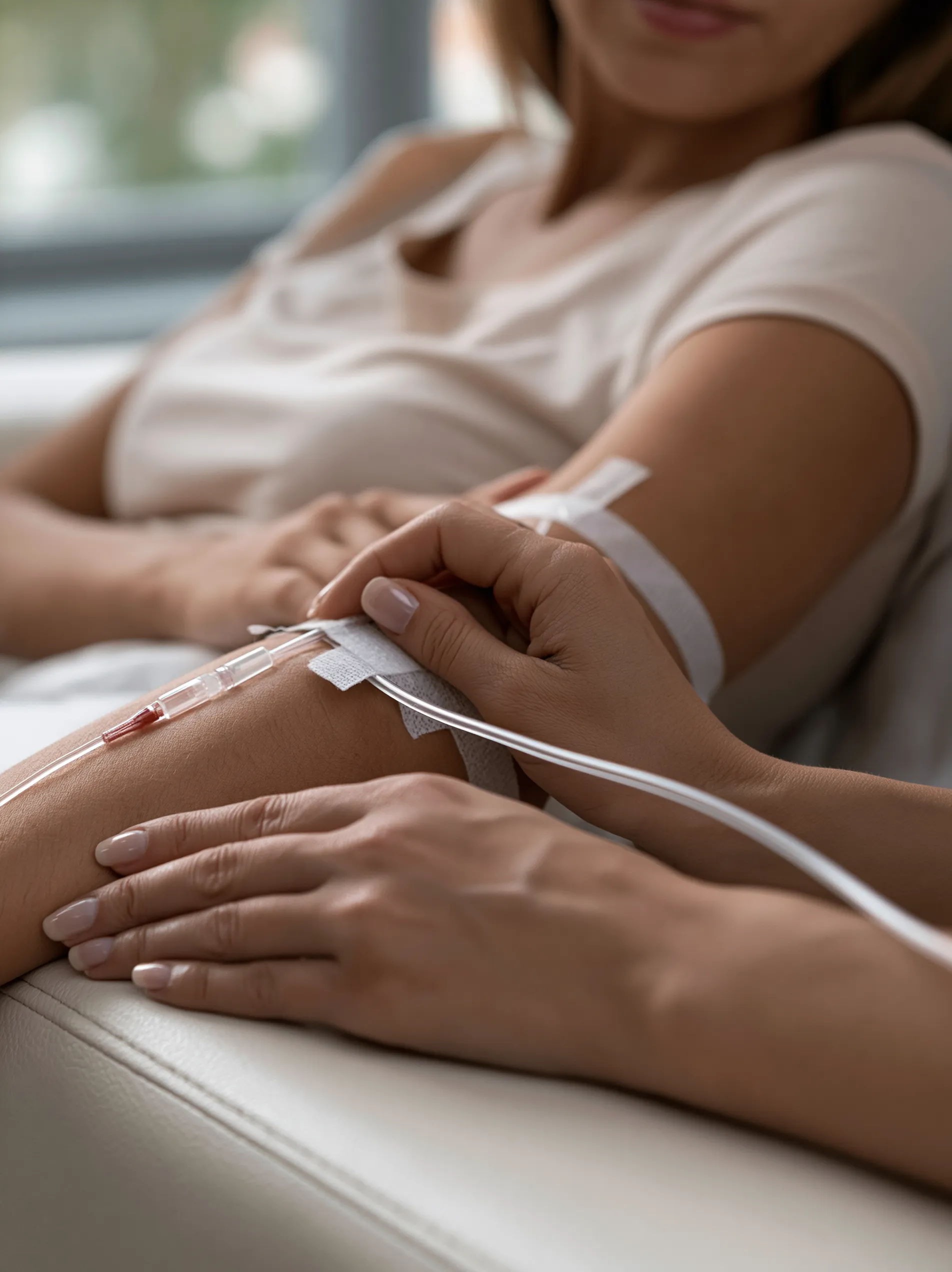
Inserting a peripherally inserted central catheter (PICC)
The catheter runs from an arm vein to a central vein
02
When a PICC is considered

The decision follows from the length of treatment, the drug being given and the state of the veins.

A PICC is not needed by every patient. Infection risk and the patient's general condition are weighed before the medical staff decide whether it is warranted.

01
Long courses of antibiotics
When antibiotics must be given intravenously for days or weeks, a PICC can spare the patient repeated cannulation.
02
Chemotherapy and irritant drugs
Some chemotherapy agents and other irritant drugs are difficult to give repeatedly through a peripheral vein, so central access may be needed.
03
Concentrated nutrition
Where eating is difficult or intravenous nutrition is needed long term, central access is sometimes required rather than a peripheral vein.
04
Veins too fragile for repeated injection
With older age, chronic illness, repeated admissions or previous chemotherapy, arm veins can become hard to cannulate, and a PICC may be considered.
The burden of repeated injections —
there is a way to keep treatment on course
03
Before insertion

"The veins are hard to find" is not on its own a reason to place one.

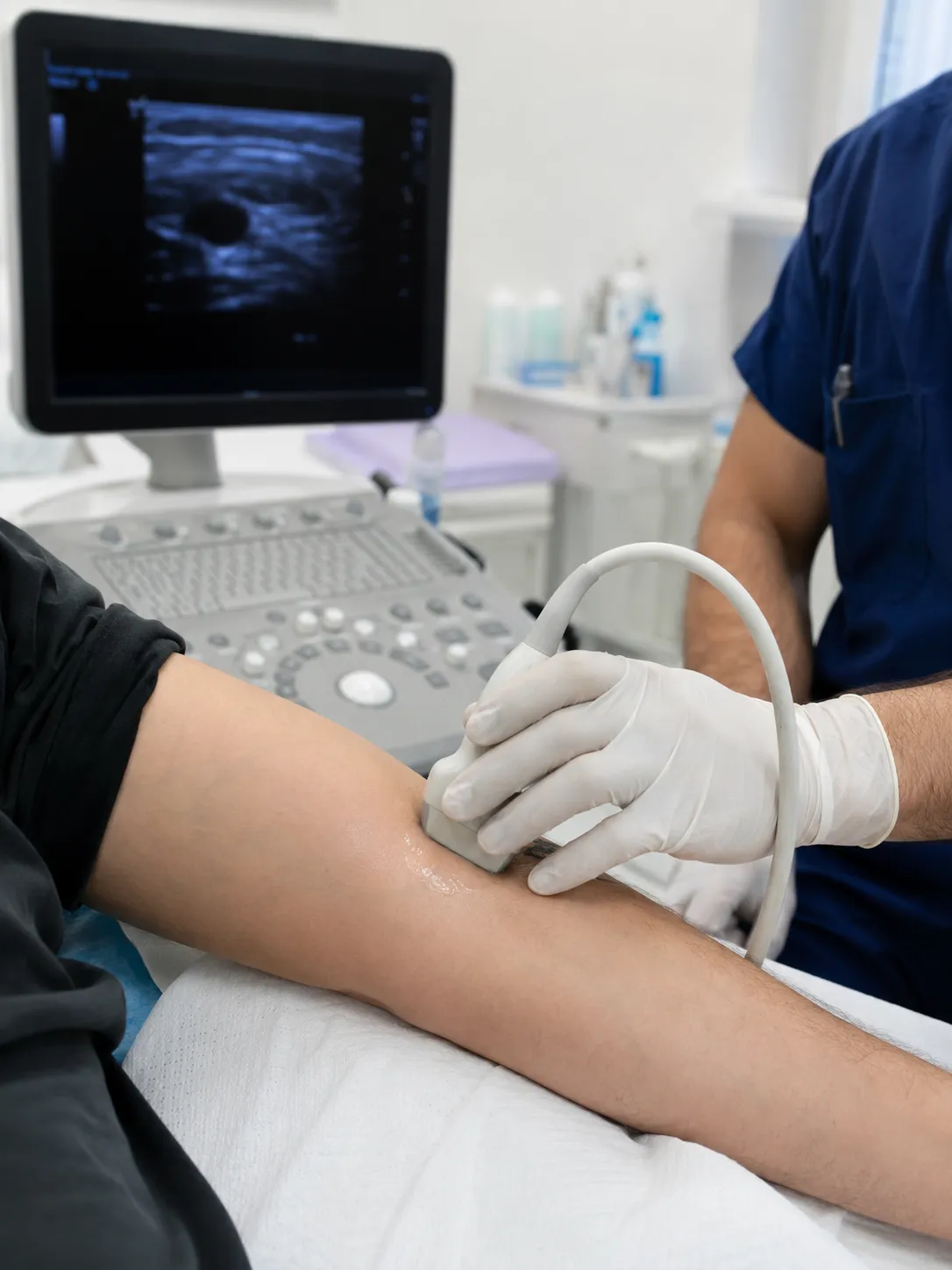
We first establish the purpose of treatment, how long it will run and the properties of the drug. We then examine the arm veins and, where needed, use ultrasound to confirm the calibre and course of a vein suitable for insertion.
Length of treatment and drug properties
Ultrasound to confirm vein calibre and course
Assessment of clotting, infection risk and thrombosis risk
Existing vascular disease and current medication
Suitability depends on the patient's condition and the aim of treatment
Pre-procedure ultrasound of the upper arm veins
Pre-procedure ultrasound of the upper arm veins comes first
04
How a PICC is placed

From assessing the vein to confirming the tip position, step by step.

STEP 01
Assess the vein
Ultrasound confirms a vein of suitable calibre and course
STEP 02
Choose the site
Select a suitable arm vein; local anaesthetic if needed
STEP 03
Insert the catheter
Advance the catheter toward the central vein
STEP 04
Confirm and instruct
Confirm the tip position, then teach dressing and care
05
Why aftercare matters

A PICC has to be understood together with its aftercare.

Part of the catheter remains outside the body. Good care helps reduce infection, blockage, dislodgement and movement of the tip.

Keep the site clean
Regular cleaning and dressing changes are needed. If the dressing becomes wet, lifts or is soiled, have it checked by the medical staff.
Prevent blockage
Flushing is needed even when the line is not in use, as instructed. Patients should not handle the catheter or attempt to inject anything themselves.
Keep it dry
Protect the site when showering. Avoid baths, pools and saunas where the catheter could be submerged.
Avoid pulling or kinking
Take care that the line is not pulled when dressing or moving. If the external length looks different, do not push it back in — have it checked.
06
Symptoms to report

If any of these appear after placement, tell the medical staff.

These can relate to infection, thrombosis, movement of the catheter or blockage, so they should be assessed rather than judged at home.
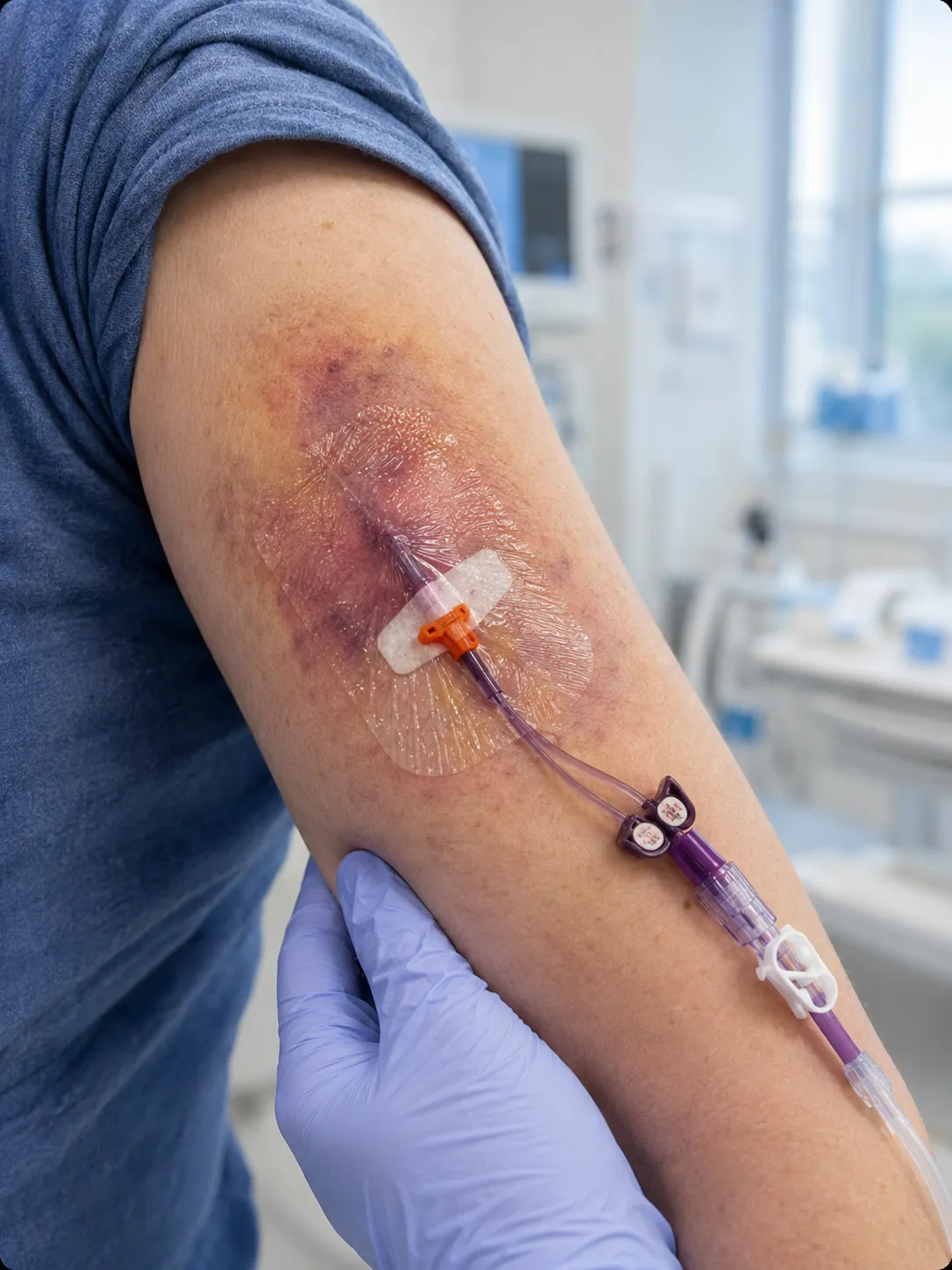
Redness or warmth at the site
Discharge, blood or pus
Swelling and pain in the arm or hand
Pain or resistance when the line is flushed or used
The external length has changed, or the line looks dislodged
Fever, chills or sudden malaise
Checking for infection and other complications after PICC placement
If these appear, contact the medical staff at once
07
PICC and port compared

A PICC and an implanted port differ in structure and in how they are cared for.

Which suits better depends on the length of treatment, the drug, the veins, daily life and infection risk.

Device
Placement and structure
Care
PICC
Arm vein to central vein; part of the line stays outside the body
Relatively simple to place and remove; dressing and infection care matter
Implanted port
A port sits under the skin and is accessed with a needle when needed
Nothing shows externally; placement and removal each need a procedure
Veins may look alike from the outside,
but course, calibre and elasticity change the approach
08
PICC care at Bluesky Phlebology

We look at the veins and the aim of treatment together.

We assess the arm veins, the purpose and expected length of treatment, any existing vascular disease, and the risk of infection and thrombosis. The clinic is in Oncheonjang, Dongnae-gu, Busan, and is reached easily from Dongnae-gu and Geumjeong-gu as well as Yangsan, Gimhae and the wider Gyeongnam region.

3,000+
of vascular surgery experience
30 years
as a university hospital professor
1
One specialist throughout
Ultrasound first confirms suitability and the right vein
We advise the venous access that suits the drug and the timeline
We explain whether a PICC or a port fits the situation
We take time over dressing, infection prevention and daily care
Attention to small symptoms and subtle changes in the vein
Dr. Bang Jeong-hee, PICC specialist at Bluesky Phlebology
Dr. Bang Jeong-hee
Vascular surgeon · MD, PhD · Former university hospital professor
09
FAQ

PICC — frequently asked questions

Is a PICC different from an ordinary IV line?
+
Yes. An ordinary IV line usually sits briefly in a peripheral arm vein, while a PICC runs from the arm to a central vein. It is considered for long courses of IV treatment or for drugs that irritate the vein.
How long can a PICC stay in?
+
That depends on the treatment plan, whether infection occurs, the state of the catheter and how it is cared for. It is removed or replaced once treatment ends or if infection, blockage or thrombosis develops.
Is insertion painful?
+
Local anaesthetic can be used during insertion, which helps. Sensitivity varies between patients, and some aching or awareness of the line is common afterwards. Worsening pain, swelling or warmth should be checked.
Can I shower with a PICC?
+
Often yes, provided the site and connections are protected. A wet or lifted dressing raises the infection risk, so follow the method you were shown. Avoid baths, pools and saunas where the catheter could be submerged.
What if the PICC blocks?
+
Do not force it or try to flush it yourself. Blockage can come from clotting, drug precipitation or a kink in the line, so it needs to be assessed by the medical staff.
Is swelling or pain in the arm normal?
+
It can be simple discomfort, but it may also relate to thrombosis or inflammation. Swelling of one arm only, worsening pain, warmth or fever should be seen.
Can anyone have a PICC?
+
No. Where the arm veins are too small or occluded, where a central vein is narrowed or blocked, or where the risk of infection or thrombosis is high, another route may be needed. Suitability follows from the patient's condition, the ultrasound findings and the aim of treatment.
Book a Visit

Repeated injections and fragile veins —
have the veins
assessed first.

When a long course of antibiotics, chemotherapy, intravenous nutrition or repeated injections is ahead, "the veins are hard to find" is not something to work around. We help find the venous access that fits the drug and the timeline.

Book a visit